.png)
Enterprise Kanban + AI: Predicting Dependency Risk Before It Becomes Failure
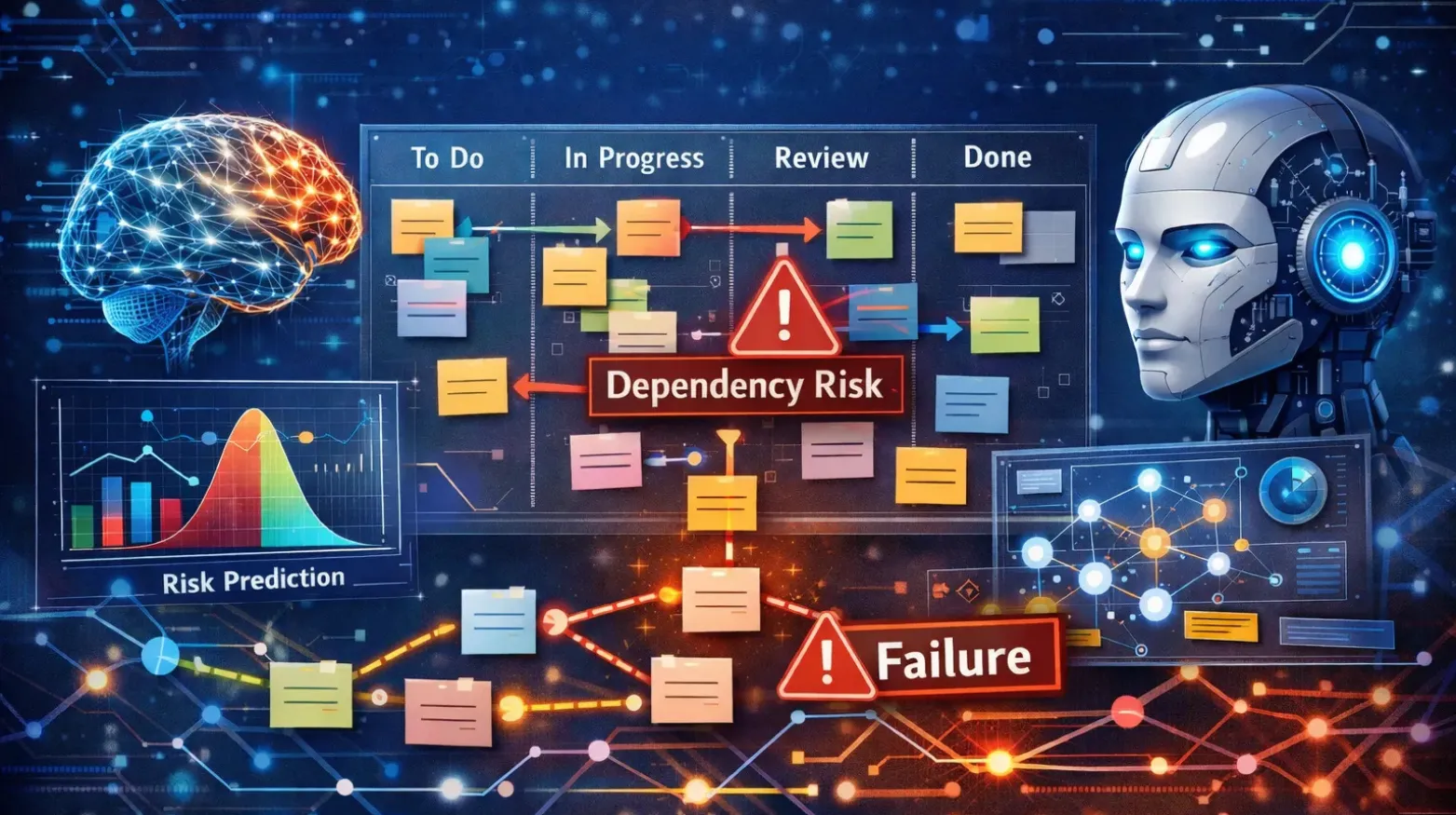
Large enterprises rarely fail because teams cannot deliver work. They fail because dependencies fail silently — between teams, systems, approvals, vendors, and decision-makers. By the time a bottleneck becomes visible, the damage is already done.
Enterprise Kanban, when augmented with Artificial Intelligence (AI), shifts dependency management from reactive firefighting to predictive, system-level risk mitigation. Instead of discovering problems late, organizations gain the ability to see fragile paths early, forecast impact, and intervene deliberately.
This is not about adding AI for novelty. It is about making complex delivery systems observable, predictable, and governable.
What: Enterprise Kanban + AI as a Dependency Risk System
Traditional Kanban excels at visualizing work in progress and surfacing bottlenecks as they emerge. At enterprise scale, however, the real risks live outside individual team boards — in the connections between teams, approvals, vendors, and platforms.
Enterprise Kanban extends Kanban beyond a single team into a connected value stream, linking:
- • Portfolio → Program → Team workflows
- • Business, technology, risk, compliance, and vendor work
- • Internal teams and external dependencies
When AI is layered on top, this system becomes predictive rather than descriptive.
AI-augmented Enterprise Kanban can:
- • Continuously analyse historical and real-time flow data
- • Identify fragile dependencies across teams and functions
- • Predict where delays are likely to occur
- • Quantify risk before it impacts delivery timelines
The result is a living system that anticipates failure instead of reacting to it.
Why: Dependency Risk Is the Real Enterprise Problem
At enterprise scale, delivery is rarely blocked by lack of effort. It is blocked by:
- • Approval delays across governance layers
- • Vendor response latency
- • Shared systems becoming single points of failure
- • Hidden handoffs between teams
- • Dependencies that surface only when it is too late
Most organizations discover these issues during escalation calls, executive reviews, or go-live weekends — when options are limited and costs are high.
AI-powered Enterprise Kanban addresses this gap by focusing on dependency risk as a first-class signal, not an afterthought.
Key Benefits
Predictive Risk Assessment
AI analyses historical cycle times, blocked durations, approval lags, and vendor performance to forecast where bottlenecks are likely to emerge — before teams feel the impact.
Automated Dependency Tracking
Across large organizations, AI connects signals from multiple boards and systems to uncover hidden dependencies and duplicated effort that individual teams cannot see.
Intelligent Prioritization
Work is prioritized not only by urgency, but by dependency criticality, team capacity, and downstream impact, ensuring that fragile paths receive attention early.
Enhanced Visibility Across the Value Stream
Dependency visualization — often described as “red string” mapping — makes relationships between tasks explicit, preventing one team’s delay from silently stalling many others.
A Hard Truth: Enterprise Kanban’s Biggest Challenge Is Communication at Scale
Enterprise Kanban does not fail because teams resist visualization. It struggles because communication degrades as scale increases.
As the number of teams, stakeholders, and approval paths grows:
- • Cross-team communication drops
- • Context is lost between handoffs
- • Ownership becomes ambiguous in dotted-line reporting
- • Approvals fade into inboxes, chats, or informal conversations
- • Decisions get delayed without anyone explicitly blocking work
In many enterprises, the board looks healthy while reality is not — because the real dependency lives outside the visible workflow.
This is where Kanban alone reaches its limits.
How AI Addresses Cross-Team Communication Breakdown
AI does not replace communication — but it stabilizes it by making invisible dependencies explicit and time-bound.
1. AI Surfaces “Silent Dependencies”
AI models analyse patterns such as:
- • Repeated approval delays from the same role or committee
- • Work items consistently blocked after moving into specific states
- • Dependencies that only surface late in delivery cycles
Instead of relying on human memory or escalation, AI flags emerging risk automatically — even when no one has raised their hand.
2. Approval Drift Detection
In large organizations, approvals often fail not because they are denied — but because they are forgotten.
AI can track:
- • Approval request → response time trends
- • Missed or overdue approvals
- • Escalation paths that are not being triggered
This restores accountability without adding manual governance overhead.
3. Dependency-Centric Prioritization
Rather than prioritizing based only on deadlines, AI evaluates:
- • Downstream dependency impact
- • Number of teams waiting on an item
- • Probability of cascading delays
This ensures teams work on what unblocks the system, not just what appears urgent locally.
4. Predictive Communication Signals
Advanced implementations analyse sentiment and interaction patterns to detect:
- • High-stress zones
- • Teams consistently overloaded by dependencies
- • Early signs of disengagement or burnout
These signals help leaders intervene before coordination breaks down completely.
How: Implementing AI-Driven Dependency Risk Management with Enterprise Kanban
Mapping Cross-Team Dependencies
Use hierarchical boards to connect work across departments such as development, design, QA, operations, procurement, and compliance. Dependencies must be modelled explicitly — not assumed.
Visualizing Blockers and Fragile Paths
Flagged cards, dependency links, and red-string-style visualizations make it clear where work is waiting, why, and on whom.
Buffering for Uncertainty
Kanban enables intentional buffers for high-risk dependencies — allowing preparatory or parallel work to absorb inevitable delays and prevent cascading failure.
A Realistic Enterprise Use Case
Consider a large enterprise running multiple concurrent transformation initiatives across finance, operations, and customer platforms.
Despite having Kanban boards at team level, delivery issues kept surfacing late — primarily due to:
- • Shared data readiness dependencies
- • Central approval forums becoming bottlenecks
- • One team’s delay cascading across three others
By introducing Enterprise Kanban with AI-driven dependency analysis, the organization was able to:
- • Link team boards into a single value-stream view
- • Identify approval and integration steps with high delay probability
- • Flag fragile paths weeks before milestones
- • Reprioritize work to unblock multiple teams simultaneously
The outcome was not “faster teams,” but fewer late surprises, clearer ownership, and better executive decision-making based on early signals rather than post-facto escalations.
This kind of implementation requires not just tool knowledge, but a deep understanding of how enterprise delivery, governance, and decision-making actually work in practice.
Conclusion: Visibility Alone Is Not Enough
Enterprise Kanban creates transparency.
AI adds anticipation.
At scale, the challenge is no longer tracking work — it is tracking what is about to break due to communication gaps, approval drift, and hidden dependencies.
When Enterprise Kanban is augmented with AI:
- • Communication breakdowns become measurable
- • Dependencies become manageable
- • Risk becomes predictable rather than surprising
In complex organizations, delivery excellence is not about moving faster.
It is about seeing risk earlier and coordinating better across the system.
That is the real promise of Enterprise Kanban + AI.


.png)